Friday, March 29, 2019

Natural Selection - Hunter Jones

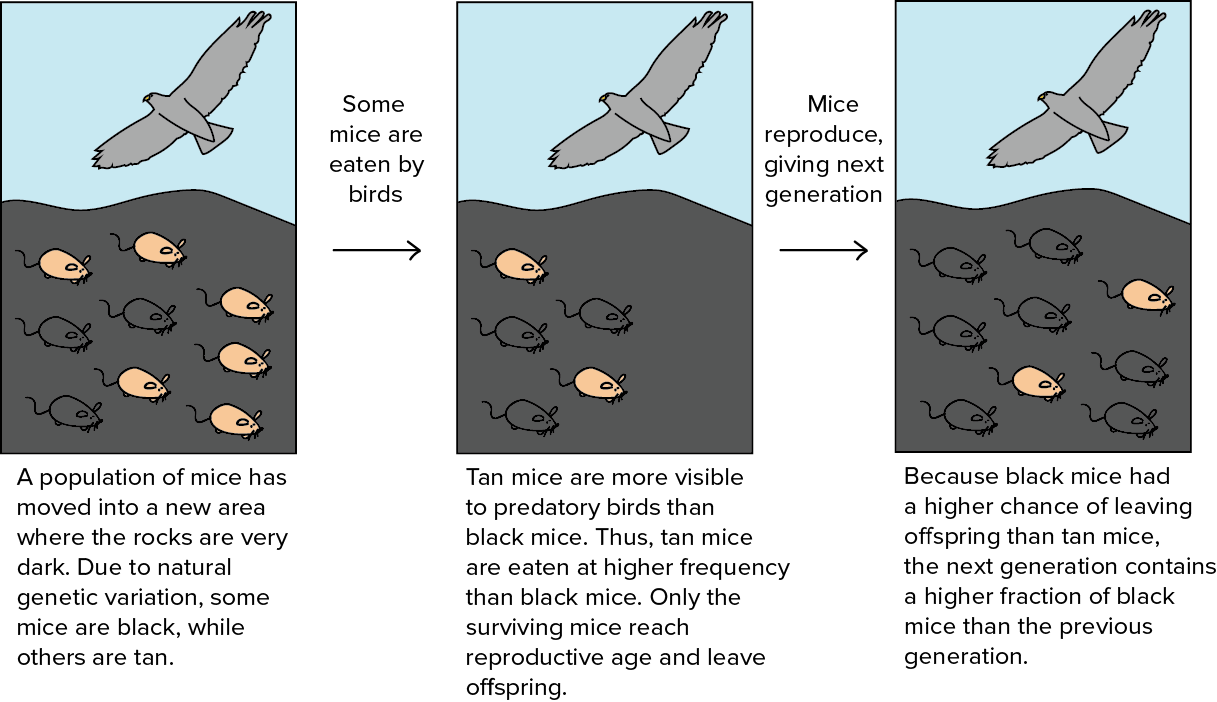
Natural selection is the natural process of living organisms who cannot function efficiently dying off.
For example if a giraffe isn't tall enough to reach the leaves on a tree it won't be able to eat and end up dying of starvation. Natural selection also deals with evolution and the overall health of a population. Sense the animals who can't survive die off they don't get a chance to reproduce and have offspring that could potentially be born with the same inabilities that keep them from surviving. Overtime natural selection should make a population stronger however it the group of organisms are all unable to survive natural selection will cause them to go extinct.

Summary
I have learned that natural selection occurs in all living organisms, not just animals but plants and cells too. It doesn't matter what organism it is if it isn't able to do what it needs to survive eventually it will die and leave the stronger organisms who survived to reproduce. This minimizes the chance of another organism that can't survive on its own being born. 

Citations
https://creationscience4kids.com/can-natural-selection-make-anything/

Thursday, March 28, 2019

Carbohydrates

Image result for carbohydrate
Organic Compound


  • Made up of Sugars, Starches, and Fibers
  • Carbs provide your body with energy
  • The building block of a carb is monosaccharides
  • The elements that make up a Carb is a Carbon, Hydrogen, Oxygen

Plasma Membrane

Image result for plasma membrane
The plasma membrane is the outer rim of a cell that holds everything in the cell together in the cell space.

It allows things to enter and leave the cell.

"Biologywise." BiologyWise. N.p., 2019. Web. 28 Mar. 2019.

Blood Types

                                         Blood Types


 Blood type: A blood type is a classification of blood, based on the presence and absence of antibodies and inherited antigenic substances on the surface of red blood cells

- Categorizing blood according to type helps prevent reactions when someone gets a blood transfusion. Red blood cells have markers on their surface that characterize the cell type. These markers (also called antigens) are proteins and sugars that our bodies use to identify the blood cells as belonging in us.

- There are 8 different possible blood types known as: O negative, O positive, A negative, A positive, B negative, B positive, AB negative, and AB positive.

- Two main blood groups: ABO and Rh

Why are blood types important? The immune system is the body's protection against invaders. It can identify antigens as self or non self. To get a blood transfusion safely, a person's immune system must recognize the donor cells as a match to his or her own cells. If a match isn't recognized, the cells are rejected. (https://kidshealth.org/en/teens/blood-types.html) 


Wednesday, March 27, 2019

Aerobic Energy Production


Aerobic Energy - Creates ATP with oxygen. ATP
- Glucose and Oxygen make ATP
- Aerobic Energy creates the most ATP due to having more oxygen
- Produces ATP slower compared to other ways.

Summary: Aerobic Energy is the best method in creating ATP due to it being able to use more oxygen but doesn't allow for ATP to be made very quickly.

Citations:
"The Aerobic System." PT Direct. N.p., 2019. Web. 27 Mar. 2019.

-Ryder Edwards


Mutations


A mutation is when the DNA of an organism is permanently changed during replication.  

Potential Positives:
  • New adaptations to environment 
  • New DNA in gene pool 
  • Resistance to viruses or disease 
  • Necessary for evolution 
  • Variations


Potential Negatives:
  • Genetic disorders
  • Diseases
  • If gene is spread, could harm an entire population.

Examples of mutations:
  • Cancer cells
  • Sickle Cell Anemia
  • Two brown eyed parents = blue eyed child


Editors. "Substitution Mutation: Definition." Substitution Mutation Definition. https://biologydictionary.net/substitution-mutation/

By Sacha Jacques

Natural Selection


Image result for natural selection picture


- Organism changes to better survive in habitat
- This theory was created by Charles Darwin
- Key mechanism of evolution
- Acts on phenotype of an organism 


Summary:
Natural Selection is a theory that states an organism overtime develops characteristics and features that lets it's species better survive in the environment. An example of natural selection would be; say there is a group of red bugs and then a group of purple bugs, and the red bugs are being eaten by the birds but the purple bugs are not. The purple bugs would then become more populated and would take over because that species of bug has better adapted to the environment they are in. Something that surprised me when learning about this is that, this happens everywhere within humans, ways of life etc.. we are constantly changing and evolving.. We are finding new ways to make things better and easier for us. I enjoyed learning about this because it's interesting to see how far things in life have came, and how we naturally overcome obstacles over a period of time.

Citation: Paul, Kerris. "Darwin, Evolution, & Natural Selection". Khan Academy, 2019, https://www.khanacademy.org/science/biology/her/evolution-and-natural-selection/a/darwin-evolution-natural-selection.

(Shelby Goff)

ATP & it's uses

-ATP stands for Adenosine triphosphate.
-ATP is a high energy molecule found in every cell.

Summary: This molecule provides the maximum amount of energy for the cell and it is the best kind of energy a cell can get.

Citation: Adenosine triphosphate. (2019). Retrieved from https://en.wikipedia.org/wiki/Adenosine_triphosphate


Function & Structure of DNA


  • The function is to carry gene cells
  • The scientific name is deoxyribonucleic acid
  • spiral latter shaped 
  • held together by hydrogen bonds
  • cytosine, guanine , adenine, thymine 

Genetic Variation: Random Assortment

Random assortment is when the chromosomes are sorted randomly in the daughter cells. This process happens during meiosis, which is the process that cells carrying half the genetic information combine to form new organisms.

- Random or independent assortment shuffles genes into unique combinations, this is the reason for variation in the way children look from their parents and from their siblings.

- Cells dividing during meiosis cause homologous chromosomes to randomly distribute and give gametes (specialized sex cells) unique combinations of chromosomes and a unique genetic makeup.

- Without genetic variation, we would all be the same and the human population wouldn’t be able to survive things like disease.


It was interesting to learn about this because it really shows how we all look so different, and without this process we would be completely the same. It's intriguing that something so small as variation of chromosomes can affect how we all look and keep our appearances varied.


Citations:

https://www.sciencelearn.org.nz/resources/208-meiosis-inheritance-and-variation

https://www.ck12.org/biology/genetic-variation/lesson/Genetic-Variation-Advanced-BIO-ADV/
Enzymes
 Image result for enzymes Enzymes act as a catalyst for organisms. They are also what helps chemical reactions happen without enzymes there would not be any chemical reactions.They are very important in the medical field.

I was not aware the enzymes were the main reason chemical reactions happened .They are alot more important than I thought.

Tuesday, March 26, 2019

Cellular Respiration - Katelyn Allen


Main Ideas:

- Cellular Respiration is the process in which Oxygen and Glucose are released to make chemical energy for cells within all organisms.

- This process occurs in the mitochondria in the form of ATP

- There are two types of cellular respiration: aerobic (with oxygen)  and anaerobic (without oxygen)

- The balanced equation for cellular respiration is C6H12O6 + 6O2 = 6CO2 + 6H2O

- The reactants include C6H12O6 (glucose/sugar) and 6O2 (oxygen)

- The products include 6CO2 (carbon dioxide) and 6H2O (water)

Summary:

- I have learned that cellular respiration is responsible for cellular energy and takes place within the mitochondria which releases ATP. Before researching I had known most of the information I had found. Some things that I did not know were that the mitochondria has several parts including the cristae which allows energy to cover the entire organelle. What surprises me most about this topic is that anaerobic processes could occur meaning that energy could still be spread without oxygen like in fermentation or lactic acid. I enjoyed researching this topic because I was able to learn and visualize how energy is actually created.

Citations:

- https://kids.britannica.com/students/article/cellular-respiration/603291

- https://www.ck12.org/book/CK-12-Life-Science-For-Middle-School/section/4.3/

- https://www.bbc.com/bitesize/articles/zcsbmsg

Active Membrane Transport- Kylie Dye


Active Membrane Transport- Kylie Dye


  • Cell/plasma membrane: Semi/selectively permeable boundary of the cell

  • Active transport requires energy

  • Uses a high-to-low concentration

Summary:
In this review, I learned that active membrane transport requires energy and goes from a high-to-low concentration. Nothing seemed to surprise me, but I liked how quick the concept was to grasp. I feel like I had heard about this before and I think I knew more than I gave myself credit for, but I still learned many new things in this area of biology. This objective is very interesting and I liked the way Mr. Black taught it to the class because he made it very creative and fun for everyone. Outside of biology I know I can use this process to look at processes going on inside the human body. I can also look at things like perfume and know that that is passive transport and not active.


MLA Citation:

Khan Academy. (2019). Active transport. [online] Available at: https://www.khanacademy.org/science/biology/membranes-and-transport/active-transport/a/active-transport [Accessed 27 Mar. 2019].

Mia Carlson - Chloroplasts


https://www.nature.com/scitable/topicpage/plant-cells-chloroplasts-and-cell-walls-14053956


Main Ideas:

  • Chloroplasts are only found in plant cells
  • They are found on the leaves of a plant
  • They carry out photosynthesis
  • They have a green pigment inside of them called chlorophyll
  • Contain thylakoids, which are discs inside of it

Reflection:


• I learned that chloroplasts carry out photosynthesis, and what is inside of them.

By: Mia Carlson

Scientific Method

Scientific Method

Image result for scientific method


The scientific method is a stepped process used during scientific experiments that is meant to explore observations and uses a question and answer process to test for results.

Steps of the Scientific Method:

Problem: The problem is what you are looking to figure out during your actually experiment, or the basis.
Research: Rather than going straight to an experiment you want to conduct research to help you find the best way to do things and insure that you don't repeat mistakes from the past.
Hypothesis: A hypothesis is an educated guess used to state your inference on how the experiment with result.
Run Experiment: Running the experiment is the process of testing your hypothesis in order to get to your conclusions. During the experiment there is always a dependent variable which is what you measure, and an independent variable which is what you purposely change. Then you must also key a control or a constant in order to set a baseline and run the experiment.
Analyze/Conclusion: The conclusion or analysis of the experiment is when you examine the results of experiment and look back to see if your hypothesis was correct.

Citations:

-Science Buddies. “Steps of the Scientific Method.” Science Buddies, Science Buddies, 7 Feb. 2019, www.sciencebuddies.org/science-fair-projects/science-fair/steps-of-the-scientific-method.
-“The Scientific Method.” Khan Academy, Khan Academy, www.khanacademy.org/science/high-school-biology/hs-biology-foundations/hs-biology-and-the-scientific-method/a/the-science-of-biology.

Function, Structure & Types of RNA


Function, Structure & Types of RNA
~RNA=Ribonucleic Acid~
Fact
• Ribonucleotide in the RNA chain contains ribose(Sugar)
• Ribosomes are composed mostly of RNA
• Ribosomes compose up to about 60% of ribosomes 
by mass and providing the location where the mRNA binds
• The smallest RNA is usually about 70-90 nucleotides long
• Viruses may use RNA as it's genome 

Functions, Structure & Types 
The 3 main types of RNA are Messenger RNA (mRNA), 
ribosomal RNA (rRNA) and transfer RNA (tRNA)

 mRNA rRNA tRNA
 Structureshort, unstable, single-standard RNA, corresponds with gene encoded within DNA

 Long, stable RNA, molecules composing of 60% of ribosomes mass

 Short (70-90 nucleotides), stable RNA with base pairing. Contains amino acids and binding sites
 Function In between DNA and proteins; used by ribosomes to direct synthesis of proteins  Ensures the proper mRNA,tRNA, ribosomes during protein synthesis  Carries the correct amino acids to the active site of protein synthesis in the ribosomes 


OpenStax. “Microbiology.” Lumen, courses.lumenlearning.com/microbiology/chapter/structure-and-function-of-rna/.
Aryal, Sagar. “RNA- Properties, Structure, Types and Functions.” Microbiology Notes, 31 Aug. 2018, microbenotes.com/rna-properties-structure-types-and-functions/.


Monday, March 25, 2019

Symbiotic Relationship: Mutualism


Types of Symbiotic Relationships:
1. Commensalism
2. Mutualism
3. Parasitism

What is Mutualism?
- A relationship in which both animal and plant benefit.

Examples of Mutualism:
- Oxpeckers land on rhinos or zebras and eat other parasites that live on their skin.
-Ants and Aphids: Aphids suck sugar from the plants and the ants eat the leftovers and the ants protect the Aphids during the night.
-Ostrich and Zebra, they help each other see, eat and smell.

Citation: https://www.birdnote.org/show/oxpeckers-and-mutualism

Sunday, March 24, 2019

Photosynthesis


  • Photosynthesis occurs in plants.
  • The organelle it occurs in is the chloroplast.
  • The picture above has the equation for Photosynthesis in word form.
  • Balance Equation = 6CO2 + 6H2O + Sun --> C6H12O6 +6O2
  • Reactants - Carbon Dioxide (CO2), Water (H2O), and Sun
  • Products - Glucose (C6H12O6) and Oxygen (O2)
  • Glucose is the primary product and Oxygen is the byproduct.

I already knew about the process of Photosynthesis but I did learn what the balanced equation is and the reactants and the products. I enjoyed learning about this objective because it is something that we have known for so long, we just went into further detail.


Ducksters.com. (2019). Biology for Kids: Photosynthesis. [online] Available at: https://www.ducksters.com/science/photosynthesis.php [Accessed 24 Mar. 2019].

Alexa Sanders

Thursday, March 21, 2019

Cell Organelles: Vacuoles: Makayla Puckhaber

Cell Organelles: Vacuoles 


What are Vacuoles? Vacuoles are large organelles for storing water and salts.

How many vacuoles does a plant cell have? A plant cell has one vacuole.

How many vacuoles does an animal cell have? An animal cell has many vacuoles. 

- Plant cells vacuole is usually bigger than animal cells vacuoles. 

I learned that vacuoles are large organelles for storing things like water and salts. I also learned that they can be in plant and animal cells, but they're bigger in plant cells but animal cells have more.  


Studios, Andrew Rader. “Vacuoles - Storage Bins to the Cells.” Biology Basics, www.biology4kids.com/files/cell_vacuole.html.


Cell Organelle: Plasma Membrane

The plasma membrane is inside both prokaryotic and eukaryotic cells and it is made up of lipids and proteins and they create the phospholipid bilayer, it surrounds the cytoplasm of the cell, it is semipermeable to ions. Plasma membrane protects the cell from its external environment and transmits cellular signals. Plasma membranes have to be flexible so cells such as, red blood cells and white blood cells, can change shape as they move through capillaries.


Summary: The plasma membrane is important to cells because it protects them and allows cells to move throughout organisms. It is a phosphate bilayer that allows ions to enter a cell.

Molly King


https://courses.lumenlearning.com/boundless-biology/chapter/components-and-structure/
https://www.khanacademy.org/science/high-school-biology/hs-cells/hs-the-cell-membrane/a/structure-of-the-plasma-membrane

Karyotypes

Karyotypes Definition:  the number and visual appearance of the  chromosomes in the cell nuclei of an organism or species. ...